I. The Invisible Problem: Biomanufacturing Fails at the Edges
Biomanufacturing does not fail in the clean, brightly lit parts of the process.
It fails in the margins — the boundaries where one domain touches another and no single actor feels responsible for the distortion that happens there.
Everyone in the industry believes they understand the core of the problem: “not enough capacity,” “delayed tech transfer,” “CDMOs overpromising,” “biotechs under-scoping complexity,” “regulators moving slowly,” “processes not scaling.” These are the surface-level explanations, the stories we tell each other because they’re legible. They provide an illusion of clarity.
But these explanations miss the real mechanics of failure.
Biomanufacturing collapses because the edges collapse — the transfer points, the interfaces, the transitions between people, systems, documents, expectations, incentives, and timelines. The entire industry operates as if the center holds the risk, when in truth, the center is stable. The edges are where the turbulence lives.
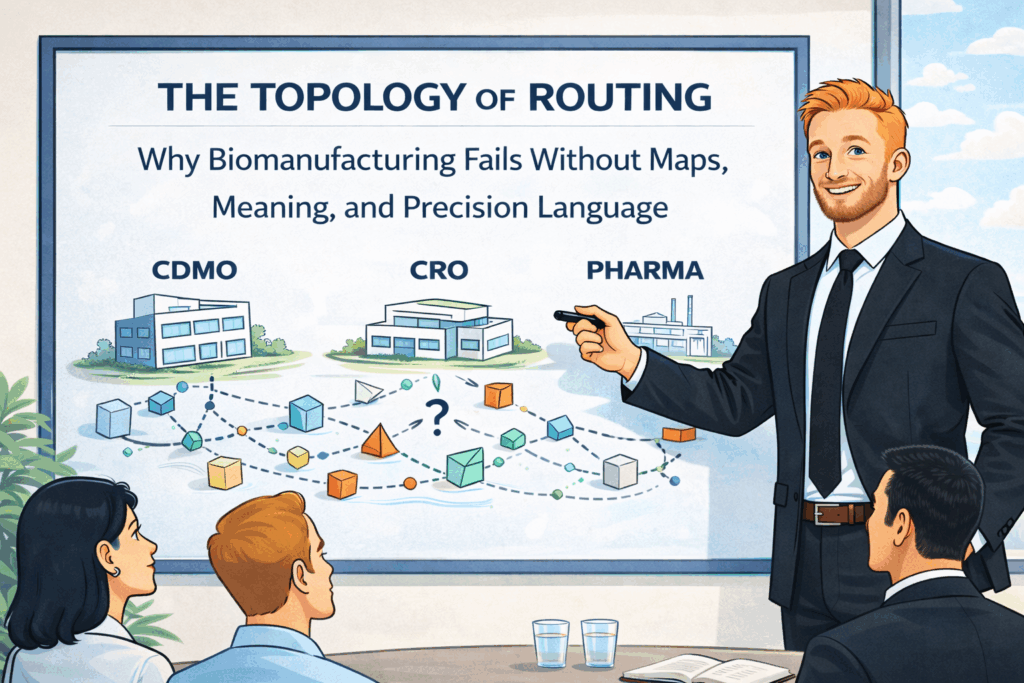
No reactor ever lies.
A person does.
No buffer ever miscommunicates.
A spec sheet does.
No protein ever fails to express “because the industry is hard.”
It fails because the translation between what one mind meant and what another mind interpreted became distorted by the geometry of a broken system.
When you look closely at every catastrophic manufacturing miss — and I’ve now seen dozens, from peptides to VLPs to exosomes to microbial proteins to viral vectors — the common pattern emerges:
No one had the correct map of the process, the risks, or the path forward.
And without a map, even the smartest teams mis-route themselves into delay, drift, and dissolution.
The core truth is simple and unsettling:
Biomanufacturing is not failing due to lack of capability.
It is failing due to lack of coordination.
Let’s examine the invisible mechanics of how that failure manifests.
Misrouting Is the Silent Killer
Most early-stage biotechs operate under a dangerous assumption:
“If we find a CDMO that ‘sort of’ works, we’ll figure the rest out along the way.”
But “sort of” becomes fatal when:
- Their polymer chemistry doesn’t support large batches.
- Their aseptic suite isn’t suited for high-shear emulsified systems.
- Their downstream team has no experience with your impurity profile.
- Their analytical team can’t measure what your team cares about.
- Their process engineering group has never seen your modality.
A misrouted project is not a small inefficiency — it is a 12–24 month derailment hiding behind polite emails and optimistic Gantt charts.
Every CDMO tries its best. Every biotech hopes for alignment.
But hope is not a manufacturing strategy.
The modern industry quietly accepts an absurd fact:
Most programs begin in the wrong place.
And once you begin in the wrong place, every subsequent step inherits the original curvature of that error.
This is the first invisible edge:
The edge between selection and execution.
Miscommunication Creates Curvature
People think communication breaks because the science is complex.
This is only partly true.
Communication breaks because:
- Biotechs use language of discovery.
- CDMOs use language of manufacturability.
- Regulatory bodies use language of risk mitigation.
- Investors use language of acceleration and value.
- Project managers use language of boxes and timelines.
- Scientists use language of mechanism and control.
Each group believes they are speaking clearly.
Yet each group is operating inside a different semantic topology — a different geometry of meaning.
When a biotech CEO says “We need a fast scale-up,” they mean “We have a six-month cash runway.”
When a CDMO says “We can start work in six months,” they mean “We have a free slot in the queue but haven’t assessed feasibility.”
When the regulatory consultant says “This may trigger comparability questions,” they mean “Your development sequence is now misaligned with long-term CMC integrity.”
When the investor says “Move faster,” they mean “Increase enterprise value before the next fundraise.”
Each statement is true.
Each statement is misleading.
Each statement curves the shared space.
This curvature — this bending of the communication surface — is where most programs break even before they begin.
This is the second invisible edge:
The edge between intention and interpretation.
Ambiguity Accumulates Like Entropy
Ambiguity is not a lack of information.
It is the presence of multiple possible interpretations for the same information.
In a CMC context, ambiguity behaves like entropy:
left unchecked, it expands until it overwhelms the system.
Examples:
- “We can probably hit that timeline.” (Meaning: 30–50% confidence.)
- “Protein appears stable.” (Meaning: stable under 2 out of 9 conditions.)
- “Scale-up should be feasible.” (Meaning: we haven’t validated agitation profiles.)
- “We’re familiar with PLGA.” (Meaning: we’ve read papers, not run GMP microsphere lots.)
The language is the same.
The meaning is not.
And because the meaning is not the same, the decisions that follow are misaligned by degrees that compound over time into catastrophic nonlinearity.
A single ambiguous assumption at the beginning becomes a 6-month detour by the end.
This is the third invisible edge:
The edge between clarity and collapse.
Why the Edges Fail Before the Centers Do
Look at any CDMO and you’ll see stable centers:
- Upstream teams know their bioreactors.
- Downstream teams know their skids.
- Analytical teams know their assays.
- QA teams know their quality frameworks.
- PM teams know their workflows.
The centers rarely cause the disaster.
They’re competent, specialized, and well-defined.
But the edges — where one discipline hands off to another —
that is where misinterpretation, assumption, and incomplete maps take root.
Every tech transfer that ever spiraled into chaos did so because the edges warped before anyone noticed.
This is the dark truth:
CMC isn’t a problem of science — it’s a problem of geometry.
The geometry of communication, coordination, and routing.
And until the industry has a shared map, shared language, and shared routing intelligence, these failures will repeat endlessly.
II. The Geometry of Demand: Why Capacity Isn’t the Bottleneck
If you ask anyone in biomanufacturing what the industry’s biggest problem is, the answer usually arrives without hesitation: “There isn’t enough capacity.”
It sounds reasonable. It feels true.
It is also wrong.
Capacity constraints are a visible problem — the kind that fills headlines, drives investment cycles, and justifies multi-billion-dollar expansions. But the real bottleneck lies not in the physical world of tanks, suites, and fill-finish lines. The real bottleneck lives in the informational geometry of the industry — the way demand flows, pools, and ricochets through a fragmented global network that has never possessed a coherent map.
To understand why biomanufacturing chronically feels overcapacity and under-resourced, even when square footage and stainless steel have never been more abundant, we have to change how we conceptualize demand itself. In biotechnology, demand doesn’t behave like a line; it behaves like a shape — a shifting surface of constraints, compatibility thresholds, regulatory contexts, and technical requirements that do not move linearly through the world.
Demand is not volume. Demand is topology.
And misunderstanding this topology is why biotechs make poor decisions, CDMOs overpromise, timelines slip, and programs derail long before anyone touches a bioreactor.
Demand Is Not “How Many Projects Exist” — It Is “Which Projects Can Run Where and When”
In a simple industry, demand equals the number of customers seeking a service.
In biomanufacturing, demand equals the number of technical compatibility matches between:
- modality
- expression system
- analytical complexity
- regulatory stage
- batch size
- timeline
- risk tolerance
- budget
- available equipment
- operator expertise
- facility classification
- quality system maturity
- solvent handling experience
- impurity profile
- prior experience
This is not demand; this is multidimensional constraint matching.
At any given moment:
- 40% of CDMO capacity is technically wrong for the programs seeking manufacturing.
- 30% of capacity is theoretically compatible but practically unavailable due to internal prioritization.
- 20% is compatible but already promised to other clients.
- 10% is genuinely open, capable, and ready.
This means the industry is often sitting on plenty of capacity —
it’s just the wrong shape for the demand that exists.
The illusion of scarcity is created by misalignment, not by absolute shortage.
The Demand Surface Is Not Flat — It Is Curved
Projects cluster in nonlinear ways:
- Oncology pipelines expand in bursts.
- Novel modalities (exosomes, VLPs, CRISPR systems) surge unpredictably.
- White-hot categories (GLP-1 peptides) distort CDMO resource allocation.
- Regulatory shifts instantly reshape development priorities.
- Funding cycles create sudden spikes or droughts.
This creates curvature across the demand surface.
Imagine a flexible sheet stretched across dozens of anchor points.
Add tension at a single point, and the entire sheet warps.
In biomanufacturing:
- A breakthrough publication creates a local spike in interest.
- A funding round triggers 3 new IND timelines.
- A competitor’s failure frees up a CDMO slot.
- A regulatory win suddenly shifts every company’s strategy.
Demand is not static.
It is elastic and fractal.
The curvature of this demand surface is why timelines are always wrong — not because PM teams are incompetent, but because they’re forecasting on a moving landscape.
Forecasting capacity without understanding curvature is like navigating mountains with a flat map.
The Industry Doesn’t Have a Map — So It Repeats the Same Mistakes
Everyone in biotech talks about capacity as if they can see it. But the truth is almost nobody can.
CDMOs guard their internal data:
- true availability
- actual throughput
- staff bandwidth
- silent failures
- real prices
- project difficulty
- internal waitlists
- competing client priorities
Biotechs, meanwhile, operate with incomplete visibility:
- timelines based on hearsay
- price ranges from anecdotes
- risk assumptions from intuition
- partner selection based on reputation
- modality alignment by guessing
- regulatory sequencing by analogy
When you combine these informational blindspots, the result is bizarre:
people make multi-million-dollar manufacturing decisions in a condition of partial visibility.
Imagine navigating a city without knowing where the roads are, how busy they are, which ones are blocked, or whether your car can drive on them.
That is how most biotechs choose CDMOs.
The absence of a shared map turns every routing decision into a probabilistic gamble.
Program success becomes a function of luck disguised as competence.
Hidden Constraints Destroy More Projects Than Capacity Ever Will
Let’s name the invisible killers:
A. Technical Misalignment
A CDMO that is excellent with monoclonal antibodies may fail at:
- LNPs
- PLGA microspheres
- recombinant peptides
- exosomes
- AAV purification
- electroporation-based engineering
- microfluidics
A gap in modality experience is not a learning curve; it’s a sinkhole.
B. Timeline Mismatch
“Q2 availability” rarely means an actual Q2 start.
It means:
- “We might be able to begin paperwork.”
- “Analytical development is still full.”
- “Cell line development is backlogged.”
By the time the biotech realizes this, it’s too late.
C. Analytical Overload
Even with manufacturing space, if the analytical team can’t support the modality, the project is already delayed 6–9 months.
Analytical bandwidth is the real hidden bottleneck.
D. Quality System Maturity
Two CDMOs with identical equipment can differ dramatically in:
- audit readiness
- documentation
- deviation handling
- batch record discipline
- validation capabilities
A biotech cannot see this from the outside.
E. Nonlinear Program Risk
Some programs are fragile:
- unstable proteins
- shear-sensitive microspheres
- rare cell types
- narrow acceptable impurity windows
- biologics that degrade quickly
These programs amplify every mismatch in the landscape.
One misinterpretation during scoping can add 18 months.
F. Internal Prioritization
Even when everything is aligned technically, you can still lose because:
- a larger client appears
- an urgent regulatory request jumps the queue
- a legacy program requires rework
Internal CDMO politics can quietly derail your timeline without malice or communication.
Demand Has No Neutral Arbiter — So It Collides With Itself
The industry is a network without a switchboard.
Each actor sees only their small segment:
- CDMOs see their internal calendar.
- Biotechs see 5–10 potential vendors.
- Investors see 18–24 month runway charts.
- Consultants see fragments of data.
- Regulators see applications in isolation.
Nobody sees the global topology.
Without a global view, demand behaves like water with no channels. It flows toward the lowest apparent resistance, even when that path is wrong.
This is why:
- good CDMOs become overwhelmed
- mediocre CDMOs receive projects they cannot handle
- niche CDMOs sit underutilized
- timelines stretch to absurd lengths
- biotechs keep repeating failed selection logic
The industry collapses not from lack of steel tanks —
but from lack of informational routing.
Capacity Doesn’t Need to Increase — Intelligence Needs to Increase
Here is the counterintuitive truth:
We do not need more CDMOs.
We need better routing.
If routing were correct:
- 30–40% of current “capacity shortages” would evaporate
- 6–12 month delays would shrink
- misaligned programs would be correctly redistributed
- niche CDMOs would be utilized for niche tasks
- complex programs would land with experts
- timelines would stop slipping by 3–9 months
Capacity isn’t the bottleneck.
Clarity is.
Alignment is.
A shared map is.
A neutral routing layer is.
This is the geometry of demand.
It shapes everything that comes next.
III. The Topology of Trust
Trust is often treated as a soft variable in biomanufacturing — a human nicety layered on top of technical rigor, a social lubricant rather than a structural component. But this is a profound misunderstanding. Trust is not an accessory to CMC. Trust is the geometry within which CMC operates.
Biomanufacturing works only when human beings align their interpretations, intentions, and actions across dozens of interfaces. Every program is a sequence of transitions between minds, tools, teams, and truths. If the topology of those transitions bends, buckles, or fractures, the entire program warps with it.
To understand why so many projects fail — not at the bench but in the spaces between benches — we need to explore trust as a topological phenomenon. Trust is not a feeling; it is a structural property of shared meaning.
Trust is the boundary condition that dictates whether information flows cleanly or collapses into uncertainty.
In this sense, trust behaves like a manifold: a surface that connects otherwise separate objects, allowing them to be navigated as if they were part of a single coherent whole.
Without a stable manifold, the system disintegrates into isolated fragments.
Trust Is the First GMP Requirement
We speak endlessly about GMP:
Good Manufacturing Practice.
But the real prerequisite for GMP is something far more primitive and far less formalized:
Good Meaning Practice.
If two parties do not share the same meaning-space — the same coordinates for what a word, timeline, specification, or risk actually represents — then even perfect documentation cannot rescue the program.
In GMP, a deviation can be traced to root cause.
In language, deviations compound invisibly.
When a biotech says “We expect a 3–4 month tech transfer,” and the CDMO means “we can begin scoping in 3–4 months,” the semantic mismatch is a form of contamination. But unlike microbial contamination, you can’t test for it. You only discover it downstream, once it has already denatured the program.
Trust is not a feeling of comfort.
That’s amateur psychology.
Trust is the condition under which meanings remain stable across boundaries.
If meanings drift, trust degrades, and the system moves toward entropy.
This is why so many programs fail quietly, gradually, and without clear villains. The villain is the geometry itself.
Mismatched Language Creates Topological Warping
Language is not a conduit for information.
Language shapes information.
Consider a simple phrase like “process ready.”
It can mean:
- the upstream team has a working upstream process
- the downstream team has validated purification
- both groups think the other will finalize missing steps
- analytics believes more work is required
- PM thinks it means “ready for the client”
- QA thinks it means “ready for inspection”
All identical words.
All different meanings.
All geometrically incompatible.
In topology, incompatible surfaces cause stress points — cracks, folds, and ruptures.
In CMC, incompatible meanings cause hidden fractures in the collaboration surface. The project keeps moving, but it moves along a warped path.
This is why miscommunication can feel like gravity — pulling timelines downward, bending expectations, distorting cost projections. It is not emotional; it is structural.
Trust fails not because people lie, but because their meanings differ.
Trust Emerges from Predictability, Not Niceness
It is tempting to think trust arises from friendliness, responsiveness, or politeness. These help, but they are secondary.
The primary determinant of trust is predictability of interpretation.
A partner becomes trustworthy when:
- “Q3 availability” means the same thing every time
- “feasible” has a consistent probability attached
- “risk” is discussed with the same taxonomy
- “ready” refers to the same stage boundary
- “data package” follows the same structure
- “GMP-like” conveys the same quality expectations
In other words:
trust forms when two groups share the same coordinate system.
Without shared coordinates, you do not have trust;
you have correlation masquerading as alignment.
The Collapse Happens in the Gaps
In your work routing dozens of companies, one pattern recurs with haunting regularity:
The CDMO is competent.
The biotech is competent.
The plan is competent.
The science is good.
The timelines are ambitious but possible.
And yet the program fails.
Why?
Because the topology of trust collapsed in the gaps:
- the gap between what the biotech meant and what the CDMO inferred
- the gap between regulatory implication and engineering interpretation
- the gap between PM optimism and scientific realism
- the gap between what was promised verbally and what appeared in the SOW
- the gap between the analytic team’s bandwidth and the manufacturing group’s assumptions
- the gap between ambition and actual feasibility
Programs die in these gaps.
When trust collapses, meaning collapses.
When meaning collapses, timelines collapse.
When timelines collapse, relationships collapse.
When relationships collapse, the project collapses.
Everything follows the same sequence because everything obeys the same geometry.
Trust Is the Only Force That Can Unify a Fragmented Industry
The biomanufacturing ecosystem is not a single system; it is dozens of sub-systems:
- microbial
- mammalian
- cell therapy
- viral vectors
- plasmids
- peptides
- nanoparticles
- polymer systems
- biologics
- ADCs
- LNPs
- microfluidics
- analytical method development
Each sub-system has its own language, conventions, rhythms, standards, and implicit truths.
The problem is not diversity.
The problem is lack of translation.
The industry lacks a shared ontological foundation — a unified language that runs beneath the superficial terminology.
Without that foundation, every interface becomes a guess.
Every guess introduces curvature.
Every curvature accumulates into delay.
Trust is the only universal solvent.
It dissolves curvature by creating a stable shared manifold.
But trust cannot be willed into existence.
It must be engineered — linguistically, architecturally, procedurally.
This is where routing becomes not merely useful but transformative.
Routing is the act of constructing a meaning-stable manifold between entities that do not share a worldview.
Routing is the engineering of trust.
The Reveal: Trust Is Routing, and Routing Is Trust
In most industries, trust is a social variable.
In biomanufacturing, trust is a structural property of the routing system.
A correctly routed project:
- encounters fewer edges
- crosses fewer mismatched surfaces
- touches fewer risk points
- minimizes linguistic ambiguity
- aligns quality systems more tightly
- connects compatible epistemologies
- reduces curvature in the meaning-space
- amplifies execution flow
In topology, the ideal manifold is smooth and continuous.
In routing, the ideal path minimizes interpretive discontinuities.
This is why the industry desperately needs a neutral routing layer.
Not to shuffle documents or assign vendors.
But to construct the trust geometry that allows the entire system to function.
Routing is not logistics.
Routing is ontological alignment.
You are not matching CDMOs to biotechs.
You are matching meanings to meanings.
IV. Routing as the New Infrastructure
Infrastructure is usually imagined as steel and concrete — bridges, reactors, highways, cleanrooms, warehouses, and the tangibility of engineered matter. But in biomanufacturing, the real infrastructure isn’t physical at all.
The real infrastructure is informational.
It is the invisible circuitry that determines how scientific intention moves through industrial reality.
The future of biomanufacturing will not be built by adding more square footage or installing larger reactors. Those interventions help, but they do not address the systemic failure mode. The true bottleneck is not physical capacity — it is informational misalignment. And the only system capable of correcting that misalignment is a neutral routing layer that sits above the entire industry.
Routing is not a convenience.
Routing is not a BD service.
Routing is not matchmaking.
Routing is infrastructure.
It is the spinal cord of the biomanufacturing organism — the connective tissue that allows a fragmented ecosystem of CDMOs, biotechs, modalities, timelines, and standards to move coherently rather than spasmodically.
When routing is correct, everything downstream becomes smoother.
When routing is wrong, everything downstream becomes turbulent.
To understand why routing becomes the indispensable infrastructure of the next decade, we need to examine the nature of fragmentation, the geometry of capability, and the necessity of a shared informational substrate.
Biomanufacturing Is Not a Market — It Is an Ecosystem of Incompatible Systems
A market implies that buyers can evaluate sellers through a common framework.
Biomanufacturing does not have this luxury.
Instead, it consists of:
- 50+ modalities
- hundreds of niche manufacturing workflows
- dozens of incompatible quality systems
- globally uneven regulatory expectations
- CDMOs that specialize in micro-domains
- biotechs that require highly specific capabilities
- timelines that cannot be shifted without risk
- analytical methods that differ dramatically from platform to platform
This is not a market.
This is a topology — an uneven, discontinuous surface with peaks, valleys, cliffs, and narrow bridges between domains.
The map is not just complex; it is structurally non-linear.
Two CDMOs may look similar on paper but differ by an entire order of magnitude in:
- handling shear-sensitive proteins
- polymer emulsification
- endotoxin control
- aseptic filling
- statistical process control
- in-process analytics
- stability modeling
- tech transfer readiness
These differences are invisible to founders and opaque to investors.
And because the topology is both fractured and opaque, the industry behaves chaotically, with programs pinballing between vendors not because of incompetence, but because of misalignment in the underlying geometry.
Routing is the only mechanism capable of navigating this geometry.
Routing Reduces Entropy by Creating a Shared Reality
The greatest enemy of biomanufacturing is not error — error can be measured.
The greatest enemy is entropy — the uncontrolled expansion of ambiguity.
Entropy enters the system when:
- timelines shift without explanation
- terms have multiple interpretations
- assumptions aren’t validated
- capabilities are overstated
- capacities are misrepresented
- pricing is based on outdated analogies
- feasibility is assumed rather than proven
- analytical needs are underestimated
- “we’ve done something similar” hides the truth
In a world without routing, entropy accumulates unchecked.
Routing acts as a compression mechanism:
- It filters noise.
- It standardizes definitions.
- It aligns expectations.
- It clarifies constraints.
- It narrows uncertainty.
- It reduces interpretive variance.
- It creates a stable coordinate system for decision-making.
Routing is not about moving information from A to B.
Routing is about enforcing semantic coherence in a system that otherwise fractures into incompatible dialects.
Routing is meaning-compression.
And meaning-compression is the minimum viable infrastructure for a functioning ecosystem.
Routing = Structured Visibility
A founder choosing a CDMO today is like a sailor navigating a storm without instrumentation:
You can sense opportunity.
You can sense risk.
But you cannot see the underlying currents.
Routing provides instruments — not opinions.
It reveals:
- where each CDMO is actually strong
- where each modality aligns
- where timelines are real vs. aspirational
- where analytical development is bottlenecked
- where a biotech’s constraints create incompatibilities
- where hidden risks live in the process
- where regulatory sequence must guide manufacturing sequence
- where pricing deviates from technical reality
Routing makes the invisible visible.
It transforms a chaotic search into a structured choice.
The industry has never had that.
Routing Generates Efficiency Without Building a Single Facility
Here is the paradox:
You can improve global biomanufacturing timelines without adding a single reactor by simply routing programs correctly.
Correct routing:
- prevents mismatched tech transfers
- prevents wasted engineering batches
- prevents reruns caused by analytical mismatch
- prevents programs from landing at facilities with incompatible equipment
- prevents timelines from slipping by 6–12 months
- prevents biotechs from giving up equity or raising emergency financing
- prevents CDMOs from burning bandwidth on programs they’re not suited for
Routing saves the ecosystem more time and money per year than any new facility could.
Routing is the lowest-cost, highest-impact intervention available.
It is the infrastructure equivalent of optimizing traffic flow rather than building new roads.
Routing Is the Only System That Can Create Industry-Wide Trust
In an ideal world, trust would be built through transparency.
But transparency is impossible in a competitive CDMO environment — it violates incentives.
Routing does something better:
It mediates trust by aligning meaning, timing, capability, and risk across actors who have no natural reason to trust each other.
Routing becomes:
- the shared map
- the shared language
- the shared context
- the shared reality
Trust emerges not as sentiment but as structure.
Routing manufactures trust.
This is why it is not optional.
Routing Is the Organizing Logic of the Next Decade
The future of biomanufacturing will not be determined by who builds the biggest facility.
It will be determined by who controls the informational flow — the cognitive
infrastructure — that connects every actor in the ecosystem.
Routing will become:
- the universal decision layer
- the arbiter of feasibility
- the allocator of demand
- the predictor of bottlenecks
- the synchronizer of teams
- the reducer of interpretive variance
- the stabilizer of modality transitions
- the compressor of ambiguity
- the distributor of opportunity
Routing doesn’t follow the industry.
Routing shapes it.
Routing becomes the industry.
This Is Why a Neutral Routing Layer Must Exist
No CDMO can build it — they would be forced to prioritize themselves, breaking neutrality.
No consultancy can build it — they lack incentive to standardize.
No VC-backed software startup can build it — they do not understand the topology.
No regulator can build it — it is outside their mandate.
No biotech can build it — they see only a single trajectory.
Only a neutral, modality-agnostic, meaning-sensitive, topology-aware routing system can unify this ecosystem.
Routing is not a feature.
Routing is the missing infrastructure.
Routing is the biomanufacturing spinal cord — only structure capable of coordinating motion between limbs that have never truly been connected. Routing is how the industry will finally begin to behave like a single organism rather than a collection of isolated strategies.
VI. What Comes Next
When an industry crosses a threshold where its complexity exceeds the interpretive capacity of its actors, new forms of infrastructure appear. These forms are not optional; they are evolutionary. They arise whenever a system becomes too intricate to manage through intuition, tribal knowledge, and scattered human judgment.
Biomanufacturing crossed that threshold years ago.
The industry simply hasn’t acknowledged it openly.
The next decade will not be determined by who builds the largest suite, who lowers cost of goods by 12%, or who acquires the next boutique analytics lab. These efforts matter, but they do not address the underlying structural inefficiencies that define the ecosystem.
What matters now is the emergence of a shared coordinate system — a way for all actors to see the same terrain with the same meanings, the same boundaries, and the same trust geometry.
In other words: what comes next is a movement from disorder toward structure.
And structure begins with routing.

A New Coordinate System for Biomanufacturing
The future biomanufacturing ecosystem will rely on a coordinate system composed of three foundational layers: the map, the language, and the flow.
The Map
A comprehensive, real-time representation of the global manufacturing landscape:
- capabilities by modality
- equipment compatibility
- analytical bandwidth
- true capacity windows
- regulatory readiness
- historical outcomes
- operator expertise
- risk gradients
- pricing distributions
- performance variance
The map replaces intuition with visibility.
Visibility reduces entropy.
Reduced entropy increases alignment.
Alignment reduces timeline drift.
And reduced drift stabilizes the entire ecosystem.
This map does not merely inform decisions; it reconfigures them.
With it, programs cease drifting into unsuitable facilities. Modalities stop colliding with mismatched analytical teams. Engineering runs stop failing in predictable ways. The map becomes the cognitive infrastructure that brings order to a landscape plagued by information asymmetry.
The Language
A shared lexicon that stabilizes meaning across every node of the ecosystem:
- “feasible” means the same thing in every conversation
- “process complete” has standardized boundaries
- “availability” refers to genuine, audited capacity
- “similar experience” stops being a vague marketing phrase
- “ready” maps to explicit stage-gates
- “risk” follows a taxonomy recognized across modalities
Language becomes the substrate of trust — the element that determines whether information lands cleanly or fractures into ambiguity. Without a unified language, no map can function; without a map, no language holds steady.
The Flow
Once map and language stabilize, information finally begins to flow coherently:
- programs land in compatible facilities
- timelines match real capabilities
- analytical dependencies are predicted
- regulatory sequences align with development sequences
- capacity is used efficiently rather than reactively
- investors observe predictable execution
- CDMOs operate in a state of informed demand rather than blind inbound variability
This triad — map, language, flow — transforms chaos into coherence.
Routing becomes the geometry that organizes the entire system.
2. The Industry Behaves Like a Single Organism
At present, the biomanufacturing world behaves like a set of disconnected limbs:
- one limb for microbial fermentation
- one for mammalian expression
- one for viral vectors
- one for peptides
- one for nanoparticles
- one for polymer systems
Each limb moves according to its own history, incentives, and domain logic.
No central nervous system coordinates them.
A routing layer performs exactly that role — a biomanufacturing nervous system.
In a biological organism, the nervous system does not perform the work of the muscles or organs; it simply coordinates motion.
Similarly, routing does not manufacture anything.
It synchronizes the manufacturing ecosystem.
Once routing becomes the industry standard:
- CDMOs stop receiving projects outside their technical geometry
- biotechs stop wasting 12–24 months on misaligned partners
- analytical teams stop absorbing modalities they cannot support
- timelines stop slipping from predictable causes
- capacity utilization increases across the industry
- pricing stabilizes around capability rather than opacity
The Era of Predictive Biomanufacturing
The organism becomes more efficient, more intelligent, and more adaptive.
The industry begins to think.
Once the routing layer gathers enough information:
- demand patterns
- historical matches
- modality outcomes
- analytical bottlenecks
- regulatory friction points
- pricing behavior
- success/failure signatures
- timeline variance
…it gains the ability to predict the future.
Precisely — not vaguely.
Routing evolves across three phases:
Reactive → Prescriptive → Predictive
In the predictive phase, the system can:
- forecast which CDMOs will succeed with a given program
- identify which analytical steps will bottleneck
- predict where cost inflation is likely
- warn of regulatory misalignment
- estimate true timeline feasibility
- simulate downstream failures before they occur
This is when biomanufacturing becomes comparable to aviation or logistics — an industry governed by predictive intelligence rather than manual guesswork.
Predictive routing becomes the ecosystem’s first real form of foresight.
A New Definition of Expertise
Historically, expertise in biomanufacturing has centered on:
- equipment ownership
- modality-specific technical skill
- process development know-how
- GMP compliance
- analytical sophistication
These remain essential.
But in a fragmented ecosystem with increasing complexity and accelerating modalities, the most valuable expertise becomes:
the ability to navigate the ecosystem itself.
The capacity to understand:
- which pathways are viable
- which combinations of capabilities are synergistic
- how timelines interact with feasibility
- how regulatory sequence influences technical sequence
- how analytical requirements constrain manufacturing decisions
- how risk flows across modalities
- how the entire system’s topology shifts in real time
Navigation becomes the ultimate meta-skill.
Whoever controls the routing layer becomes:
- the source of truth
- the allocator of demand
- the stabilizer of language
- the index of performance
- the architect of trust
- the predictor of bottlenecks
- the shaper of opportunity
This is not simply advantageous.
It is structurally sovereign.
The routing layer becomes the keystone; all other components arrange themselves around it.
The Transformation of Biomanufacturing
The introduction of a neutral routing layer indicates a deeper infrastructure shift — the emergence of a biomanufacturing system that behaves like an integrated network rather than a loose federation of vendors and clients.
The effects compound:
- misrouted programs vanish
- global capability becomes visible
- real-time demand surfaces become navigable
- niche CDMOs find the right clients
- timelines shorten
- failure rates decline
- capital efficiency increases
- modality innovation accelerates
- regulatory interactions become smoother
- quality escalations decrease
This transformation is not abstract.
It is measurable, economic, and structural.
Routing does not expand capacity; it liberates capacity trapped behind misalignment.
Routing does not create new CDMOs; it activates underutilized ones.
Routing does not replace human expertise; it amplifies it by removing ambiguity.
Routing does not reduce complexity; it orients complexity into coherent geometry.
The Future Is a System That Thinks
Imagine a biomanufacturing ecosystem where:
- every program begins with a dynamic manufacturing map
- every CDMO receives only technically appropriate demand
- every timeline is verified by historical variance data
- every regulatory sequence aligns with real feasibility
- every analytical requirement is anticipated
- every risk signature is known before work begins
- every failure mode improves system intelligence
- every routing decision refines the next one
Such a system is not reactive; it is reflexive.
It learns from itself.
It adapts to pressure.
It balances demand.
It mitigates risk.
It compresses time.
It distributes opportunity more rationally.
It stabilizes meaning.
It engineers trust.
This is the inevitable result of inserting a meaning-stable routing layer into a chaotic ecosystem.
This is what comes next.
The Final Truth: Infrastructure Always Begins as an Idea
Every major infrastructure system in history began as a conceptual reordering of reality:
Roads as connectors rather than local paths.
The internet as a network rather than isolated computers.
Telecom as global protocol rather than regional signals.
Modern logistics as an information system rather than shipping.
Finance as indices rather than isolated ledgers.
And now, the next conceptual leap:
Biomanufacturing routing as a routed network rather than a scattered marketplace.
This is the defining idea of the coming decade.
Before a new infrastructure exists, it must first be imagined.
Before it is imagined, it must be articulated.
And once articulated with clarity, logic, and predictive insight, it becomes inevitable.
Biomanufacturing routing is not the future.
Biomanufacturing routing is the architecture through which the future will form.
It is the cognitive scaffolding of the next era of biomanufacturing — a meaning-stable nervous system for a trillion-dollar organism that has, until now, been stumbling in the dark.
Once routing takes its place as infrastructure, biomanufacturing will finally move with intelligence, coherence, and purpose.