
Physical AI, Embodied Intelligence, Neuromorphic Computing, and the Industrial Future of Intelligent Machines
The Dream That Escaped the Dream
The next revolution in artificial intelligence will be measured by what intelligence can accomplish in the physical world. After years of extraordinary progress in language models, software agents, computer vision, and computational reasoning, a more consequential frontier is emerging: physical AI, the integration of intelligent computation with machines that perceive, navigate, manipulate, and act within real environments. Its development connects robotics, semiconductor architecture, precision optics, advanced manufacturing, biotechnology, and an increasingly important question of industrial economics. What happens when the intelligence we have taught to speak begins to acquire the means to act?
This transition deserves more than the familiar language of automation. A robot handling biological samples, a surgical instrument responding to tissue characteristics, an autonomous vehicle navigating a crowded street, and an industrial machine adjusting to changing materials all confront the same fundamental requirement. Intelligence must establish a reliable relationship with a world that can resist it. Objects have weight. Surfaces create friction. Light changes with distance and reflection. Biological materials behave unpredictably. Time passes while a machine calculates. Every action carries consequences that cannot be corrected by producing a more persuasive sentence.
That is why embodied intelligence represents a different engineering problem from generating information. A computational system can produce an elegant description of how to lift a glass, yet a physical machine must locate the glass, estimate its position, control its grip, compensate for movement, and prevent the object from breaking. It must perform these operations within the limits of available energy, mechanical precision, processing speed, sensor accuracy, and operational safety. The difference between knowing and doing becomes visible in the instant a machine touches something it can damage.

The commercial significance is already material. In September 2026, the International Federation of Robotics reported that approximately five million industrial robots were operating worldwide at the end of 2025, following more than 600,000 new installations during that year. These figures describe the established industrial robotics market, not the number of robots possessing general-purpose AI. They nevertheless demonstrate the scale of the installed machinery into which more capable sensing, computation, and autonomous decision-making may eventually be integrated.
Meanwhile, companies developing advanced processors, robotics foundation models, optical sensors, specialized actuators, and laboratory automation are beginning to address different components of the same emerging infrastructure. The opportunity extends well beyond humanoid robots. It includes intelligent scientific instruments, pharmaceutical manufacturing systems, medical devices, aerospace platforms, industrial inspection, and equipment capable of performing increasingly complex operations where human supervision remains necessary but continuous direct control becomes less practical.
This development also brings the question of bio-cybersecurity into the physical world. As intelligent machines acquire access to valuable scientific information and permission to influence real operations, their identity, data integrity, software architecture, and authority become inseparable from their usefulness. A machine capable of acting must be designed around who may direct it, what conditions govern its operation, and how its decisions can be understood afterward.
The larger transformation is therefore neither exclusively computational nor mechanical. It is the emergence of a new relationship between information and consequence. Human beings have long imagined machines that could extend our abilities beyond the limitations of our own bodies. Language allowed imagination to be shared. Mathematics allowed relationships to be formalized. Engineering gave those relationships material structure. Computation allowed machines to interpret instructions and modify their behavior. Robotics is now bringing these developments into an increasingly intimate relationship with the physical world.
The dream is becoming operational.
I. What Is Dream Manifest? From Language to Embodied Intelligence
The First Externalization of Dream
Dream Manifest names a particular technological and philosophical transformation: the movement through which imagined possibilities, expressed through language and organized through engineering, acquire forms capable of acting independently within the shared world.
The phrase begins with a simple observation. Human beings can form relationships between things before those relationships exist physically. A bridge is imagined before it spans a river. A scientific instrument is conceived before its components are assembled. A medicine begins as a possibility long before a manufacturing facility produces its first commercial batch. A robot may first exist as a drawing, an instruction, a mathematical description, or an imagined motion. The future enters the present through forms that can be communicated, tested, and transformed.
Dream is the open field of possibility from which such forms arise. Fantasy is the operation that selects, joins, separates, and organizes those possibilities into relationships. Being emerges when these relationships acquire sufficient organization to participate in the world and develop a history of consequences. This sequence is a philosophical account of creation rather than a scientific explanation of the historical origin of language or machinery. Its relevance to technology lies in showing how imagined structures become capable of producing effects beyond their original creators.
Language was a decisive development in that movement. A spoken word can organize behavior after the immediate experience that inspired it has ended. A written instruction can travel beyond its author. A mathematical relationship can be reproduced by people who never met the person who described it. A program can preserve instructions in a form that a machine can execute. Each development gives an organized possibility greater independence from the individual who first imagined it.
A word can survive its speaker. A machine can continue the word’s work.
The connection becomes increasingly visible when language is translated into code, and code is translated into physical operation. Consider a simple command: bring me the red cup. For a person, this sentence participates in a rich world of learned relationships. The speaker expects the listener to identify the relevant object, understand the request, move through the environment, handle the cup appropriately, and return it without damaging anything.
For a machine, the same sentence opens a chain of technical problems. It must identify what counts as a cup, determine which object is red under the current lighting conditions, understand which physical action satisfies the request, and plan a movement through the available space. It needs a model of its own mechanical limits and sufficient sensory feedback to recognize whether the task has succeeded. A seemingly ordinary sentence becomes a sequence of perception, interpretation, planning, actuation, correction, and verification.
This is why Dream Manifest is useful as more than a poetic description of robotics. It identifies the transformation from symbolic instruction into organized physical consequence. The system must carry an intention through multiple technical layers while preserving enough of its meaning to produce the intended outcome.
A machine is Dream wrapped in consequence.
The sentence does not assert that a robot has human experience. It describes the physical stabilization of an imagined capability: a form created through intelligence, language, engineering, and material organization that can subsequently participate in the world.
Mind, Body, and the Multiplicity of a Machine
A Body is a local organization through which actions become consequential. A Mind is organized relational openness: the capacity of a system to participate in, maintain, and transform relationships across a multiplicity. These terms describe structural relationships rather than granting an automatic equivalence between biological life and present-day artificial intelligence.
An intelligent machine provides an illuminating example. Its sensors encounter changing environmental conditions. Its processing systems organize signals into usable representations. Its control mechanisms coordinate actions. Its mechanical structure establishes the range of physical movements available to it. Its operating environment responds, and new measurements return to the system.
The machine’s behavior arises through this organized multiplicity. It cannot be reduced to the processor alone, the mechanical arm alone, the software alone, or the camera alone. The relationship among these components produces the operating system that interacts with the world.
This also establishes an important distinction between biological and manufactured systems. A living organism develops through evolutionary and physiological processes that are not replicated simply by assembling electronic components. A robot is an engineered system whose capabilities depend on specific hardware, software, training, and operating conditions. Yet both reveal that meaningful behavior depends on the organization of relationships rather than the isolated excellence of a single component.
The economic relevance follows directly. Investors frequently encounter companies that describe their competitive advantage as a model, chip, actuator, proprietary dataset, or mechanical platform. These may represent valuable intellectual property. But the customer’s experience is determined by how reliably those capabilities work together.
A remarkable processor inside a poorly integrated instrument produces a disappointing instrument. A sophisticated robotic model attached to unreliable sensing produces unreliable behavior. A brilliant algorithm without a commercially manufacturable platform remains a technical asset awaiting its industrial form.
A dream becomes valuable when the world can use what it has become.
II. Physical AI: The Transition From Prediction to Consequence
Why Software Intelligence and Physical Intelligence Require Different Architectures
The rise of large language models demonstrated how statistical learning at scale could produce remarkably flexible systems for interpreting and generating symbolic information. That success has encouraged researchers to investigate whether broadly trained models can similarly support robots operating across many different tasks, tools, and environments.
The connection is compelling, but the differences are fundamental.
A language model operates primarily within structured computational environments. It receives information, generates representations, and produces outputs that other systems or people may later act upon. A physical robot must coordinate interpretation and action continuously while the environment changes around it. Its predictions are exposed to gravity, inertia, temperature, wear, lighting, unexpected obstacles, and the finite response speed of electronic and mechanical systems.
If a model predicts that a certain grasp should succeed, a robot must test that prediction against the object. The object may slip. Its weight may be different from the estimate. The surface may be unexpectedly wet. The robot’s grip may disturb another object. Its sensors may briefly lose visibility. The machine must recognize the resulting change and adapt quickly enough to preserve the task.
This is the central engineering problem of embodied intelligence: the system’s useful knowledge must remain connected to the environment that continually confirms, modifies, or defeats its expectations.
In March 2025, Google DeepMind introduced Gemini Robotics, extending multimodal AI into robotic action. In June of that year, the company announced an on-device robotics model designed to support dexterous manipulation and adapt to different robot platforms while operating locally. These developments illustrate how general-purpose AI research is moving toward systems that connect language, vision, and physical action.
The broader approach is often called a vision-language-action model, or VLA. Such systems use visual inputs and linguistic instructions to help generate actions for robotic platforms. Their promise lies in reducing the need to construct a completely separate control policy for every narrowly defined task. Their challenge lies in obtaining sufficient high-quality training experience and maintaining reliable behavior when the operating conditions differ from those encountered during development.
An apparently minor change can become a major test. A robot trained to grasp familiar containers may behave differently when encountering transparent glass, reflective metal, flexible packaging, or an object partly hidden behind another object. A laboratory robot operating with predictable trays and standardized fixtures faces different challenges from a mobile machine encountering people, furniture, and changing physical arrangements.
Generality must therefore be demonstrated within a stated range of tasks, environments, equipment, and acceptable failure rates.
Intelligence Is Always Operating Against a Clock
A physical machine is constrained by the time available before its next action matters. A mobile robot approaching an obstacle has only a limited interval in which to identify the obstacle, determine an appropriate response, and change its movement. An automated manufacturing system observing a developing fault must issue a useful warning before the condition produces unacceptable consequences. A surgical instrument responding to motion cannot assume the environment will remain unchanged while information travels to a remote server and back.
Latency is therefore part of the functional definition of the system, rather than a secondary performance statistic.
Consider a robot guiding a component into a narrow mechanical opening. Its sensors measure the position of the component, and software estimates the difference between that position and the intended trajectory. A controller converts that difference into a motor command. The machine moves, new measurements arrive, and the sequence repeats. The frequency and reliability of this feedback loop determine whether the task can be performed safely and precisely.
A system that makes a highly accurate prediction too late may be less useful than one that produces a sufficiently accurate estimate within the required operating interval.
This is one reason local computation matters. Processing information on a device can reduce network dependence and avoid the delay of sending every signal to a remote data center. However, local execution introduces its own constraints: limited energy, heat dissipation, available memory, device cost, and the need to support software throughout the product’s operating life.
The future of physical AI consequently depends on careful allocation of computational work. Some tasks benefit from large cloud models and extensive training infrastructure. Others require compact processing close to sensors and actuators. A commercially effective system may combine centralized learning and simulation with highly optimized local execution.
The question is not whether every robot needs the largest possible model. It is which intelligence belongs where, operating at what speed, and under which physical constraints.
A Machine Must Learn the Difference Between a Mistake and a Consequence
In software demonstrations, success is frequently summarized through benchmark scores. In physical systems, the meaning of an error depends on what happens next.
An image classifier that mistakes one laboratory object for another may require a manual correction. The same misclassification in a robotic handling system could lead to an incorrect transfer, damaged equipment, or compromised experimental material. A false-positive maintenance warning creates inconvenience. A missed warning involving an important process condition can become economically consequential.
This does not mean all autonomous systems require the same reliability. It means their evaluation must reflect the uses for which they are intended.
A robot sorting harmless demonstration objects should not be assessed under the same operating assumptions as equipment participating in pharmaceutical production. The relevant acceptance criteria may include task success rate, intervention frequency, process reproducibility, equipment compatibility, traceability, and the cost of an unsuccessful action.
The 2025 revision of ISO 10218-1, which addresses safety requirements for industrial robots, illustrates the importance of distinguishing robotic capability from the measures required for safe physical integration. The applicable requirements depend on the machinery, application, and broader system design.
An intelligent machine becomes an industrial asset when its behavior can be trusted within a defined field of consequences.
This is a more demanding and ultimately more commercially meaningful standard than an impressive demonstration video.
III. The Physics of Perception: Before a Machine Can Act, It Must Encounter the World
Intelligence Begins With a Measurable Encounter
A robot never receives the physical world directly as a complete and unambiguous description. It receives measurements.
A camera produces signals influenced by illumination, sensor characteristics, exposure, optics, and environmental conditions. A lidar system estimates distance through the behavior of emitted and received light. A thermal sensor measures radiation within the constraints of its design. An inertial measurement unit reports changes in motion. A force sensor detects mechanical interaction. Each technology provides a partial account of the environment.
The intelligent system must organize these partial measurements into a representation sufficient for its intended task.
This is where the development of embodied intelligence becomes inseparable from the physical sciences. Advances in algorithms cannot erase inaccurate measurements or compensate indefinitely for poorly specified instruments. Sensor calibration, optical performance, signal processing, mechanical alignment, and environmental stability influence what a machine can reliably distinguish.
Imagine an autonomous robot reaching toward a clear laboratory vial. To a human observer, the object appears ordinary. To a machine, the transparent material may create reflections and distortions. The background may be visible through the container, complicating object recognition. The vial’s orientation affects the safe grasping location. Its contents may impose handling restrictions that cannot be inferred from appearance alone.
A successful operation requires several forms of knowledge to cooperate: optical perception, object identification, spatial localization, mechanical planning, and procedural context.
This is why the rapid development of physical AI also creates opportunities for the companies building cameras, optics, illumination systems, specialized detectors, calibration equipment, and photonic materials. Their technologies form the physical interface through which intelligent machines obtain information about their environments.
The intersection extends directly into biophotonics, where light-based technologies support the observation and analysis of biological systems. The techniques used to image cells, analyze chemical composition, or measure biological signals differ from those used in automotive perception, but they share a fundamental dependency on controlled measurement and reliable interpretation.
The Commercial Value of Calibration
Calibration occupies an unusual place in the technological imagination. It rarely attracts the excitement associated with a new AI model or autonomous robot. Yet a sophisticated machine can become commercially useless if its measurements drift beyond acceptable tolerances.
A manufacturing camera may require stable sensitivity and geometric accuracy. A spectrometer needs reliable wavelength and intensity relationships. A robotic inspection system must account for the relative position of its sensors and moving components. A biomedical imaging instrument must preserve the interpretability of measurements despite changes in equipment or operating conditions.
Calibration establishes the relationship between an instrument’s output and the quantities it is intended to measure. It creates the conditions under which measurements can be compared, trusted, and incorporated into decisions.
The deeper insight is that perception is an engineered capability.
A machine does not become intelligent simply by receiving more data. It becomes more useful when the information it receives supports valid distinctions relevant to its task. A million inaccurate measurements may be less valuable than a carefully calibrated sequence of observations that makes a consequential difference between two operating conditions.
This becomes particularly important as advanced sensing technologies move between industries. Optical expertise developed for aerospace applications can become relevant to medical instrumentation. Nanostructured surfaces originally developed for optical performance may influence other forms of sensing or laser integration. Scientific imaging techniques can inform industrial inspection. The possibilities are significant, although each new application introduces its own performance, manufacturing, and qualification requirements.
This is a practical example of the broader process of convergence arbitrage: recognizing that a technological capability developed in one market may possess commercially valuable applications in another, then evaluating whether the cost of adaptation is justified by the opportunity.
The most interesting companies are not always those creating entirely new scientific principles. Some discover that a capability already developed to solve one problem can become indispensable when another industry reaches the point of needing it.
Perception Is a Relationship, Not a Photograph
An intelligent machine perceives through an ongoing exchange between physical signals and organized interpretation.
A robot observing a door does not merely require an image containing a rectangle. To open the door, it needs to identify a usable handle, infer the direction of movement, estimate force, recognize the constraints imposed by its own body, and adapt as the door begins to move. The meaning of the object changes with the task.
A door can be an obstacle, an entrance, a surface, a structure to inspect, or an object to manipulate. Its identity alone does not determine the action. The relationship between the machine’s capabilities, its objective, and the environment gives the measurement operational meaning.
This relational understanding also provides a useful framework for comparing machine learning approaches. A system trained exclusively on static images may recognize objects without understanding how they behave under force. A robot trained through physical interaction may acquire more useful task-specific relationships between appearance, movement, and outcome. A simulated environment may help generate experience, but its conclusions must eventually be tested against actual materials and operating conditions.
Perception is the debt intelligence owes to reality.
The phrase captures a crucial distinction. An intelligent system can generate internal representations of remarkable sophistication, but its usefulness depends on whether those representations remain connected to the physical relationships they are intended to guide.
For investors and operators, this is one reason sensing companies deserve attention alongside model developers. The commercial system emerges through the complete interface among measurement, interpretation, and action.
IV. Neuromorphic Computing: Building Intelligence Into the Material
The Energy Problem Beneath Embodied Intelligence
As AI systems move into physical devices, energy becomes a fundamental design constraint.
A large model operating in a data center can draw upon substantial electrical power, cooling infrastructure, and specialized processors. A mobile robot, remote sensor, portable scientific instrument, or battery-powered medical device must work within a much smaller operating budget. The device may also need to respond without a reliable network connection.
These conditions have encouraged the development of specialized computing architectures designed to reduce energy consumption for particular classes of operations.
One such approach is neuromorphic computing, a family of computing methods inspired by aspects of biological information processing. The category includes event-driven systems, specialized neural processors, and emerging devices that combine elements of memory and computation. These technologies differ significantly in their physical implementations and should not be treated as a single architecture.
A particularly interesting branch investigates analog computing in memory.
In many conventional computing systems, significant energy is consumed moving data between processing units and memory. Some compute-in-memory approaches reduce that movement by allowing stored values to participate directly in calculations. Specialized resistive devices called memristors can support this principle through electrical states that represent numerical weights.
In a crossbar arrangement, applied voltages and stored conductances can produce currents corresponding to weighted sums. The electrical behavior of the array performs part of the computation.
The system converts a mathematical operation into a physical relationship among electrical components.
This is a striking development because it changes the relationship between the abstract model and the material used to execute it. The mathematical structure of a neural network can be represented through hardware properties rather than requiring every relevant operation to be performed by conventional digital circuits.
Yet it remains an engineering approach with substantial tradeoffs, not an automatic replacement for established processors.
Why the Hardware Research Matters
The commercial ambition of analog in-memory computing is to reduce the energy and latency required for suitable neural-network operations. Potential applications include always-on sensing, embedded classification, signal processing, and other workloads that benefit from localized computation.
CyberSwarm provides an example of a company pursuing this architecture. Its technical overview describes memristor-based hardware intended for applications across robotics, automotive systems, aerospace, industrial monitoring, and medical devices. The company emphasizes the use of electronic material properties to support efficient local computation.
Other companies are developing different approaches to edge intelligence, including digital neuromorphic processors and conventional low-power AI accelerators. The eventual competitive position of each approach depends on the whole system rather than the theoretical efficiency of an individual component.
This distinction is essential.
Analog electronics can experience device variation, noise, changes in stored values, and other nonideal physical behaviors. Systems may require calibration, conversion circuitry, error correction, and additional supporting computation. A component that performs an operation with very little energy does not necessarily produce a commercially superior processor once the complete hardware, software, and manufacturing requirements are considered.
A 2026 review in Nature Materials examined the accuracy challenges associated with memristor-based analog computing in memory, including the tradeoffs introduced by methods intended to compensate for device and circuit imperfections.
The investment question therefore concerns demonstrated performance under useful operating conditions.
How much energy does the complete system consume? How accurately does it perform the required task? How quickly does it respond? How much does the device cost to manufacture? How reliably does it operate over time? What software tools are available to the customer? Can the architecture be incorporated into a product without imposing unacceptable engineering costs?
The answers determine whether a promising technology becomes a platform with sustainable demand.
The Boundary Between Scientific Novelty and Commercial Necessity
A new processor architecture does not need to replace every existing semiconductor technology to become economically meaningful.
An architecture that performs exceptionally well for one narrow but valuable class of workloads may support an attractive business. A sensor company might value an inference engine that reduces energy consumption sufficiently to extend device operating life. An industrial equipment manufacturer might value lower latency. A medical-device developer might prioritize local processing of sensitive signals. An aerospace company might place particular importance on power, mass, and operating constraints.
The commercial value comes from matching the actual advantage to the application.
This is an important lesson for deep-tech venture development. Technical founders frequently describe their products in terms of the extraordinary performance that might be achievable across many industries. Investors and customers eventually require a narrower demonstration: one use case, one relevant performance comparison, one implementation pathway, and one reason that the product is preferable to the existing alternative.
The most durable platforms often emerge through this process of specificity.
A technology becomes foundational after other people discover they can reliably build upon it.
The broader implication for embodied intelligence is that processor development, sensing technology, software models, and machine design must evolve together. A brilliant neural architecture requires suitable applications. A capable robotics model requires dependable hardware. An autonomous system requires a commercial context in which its particular capabilities justify the cost of deployment.
These relationships are where a scientific idea begins to acquire an industrial future.
V. Autonomous Laboratories: Where Intelligence Begins to Produce Science
The Laboratory as a Physical Learning System
One of the most consequential applications of physical AI may emerge inside scientific laboratories.
A laboratory already represents a sophisticated relationship among instruments, people, materials, procedures, measurements, and interpretations. Researchers propose experiments, prepare samples, operate equipment, examine results, and revise their understanding. The process is iterative: each result changes what can reasonably be investigated next.
Automation has long supported this work through liquid-handling systems, robotic arms, analytical platforms, and laboratory information software. The next development connects increasingly capable computational models with the equipment that conducts experiments.
A self-driving laboratory integrates experimental planning, automated execution, measurement, and computational interpretation into a system capable of performing portions of the research cycle with limited direct human intervention.
A July 2026 review in Nature Reviews Chemistry described the evolution of these systems from specialized automation toward broader discovery platforms. The researchers emphasized scalability, generalizability, and provenance-complete experimentation as major requirements for their development.
Those requirements are revealing.
A robot that reliably transfers liquid performs useful automation. A computational platform that proposes the next experiment performs useful analysis. A system that connects the two while preserving experimental provenance begins to establish a more integrated scientific process.
The economic advantage lies in what becomes possible when these functions are coordinated.
A Scientific Experiment Has a Body
Consider a research program examining an enzyme for use in industrial biotechnology.
A computational model proposes changes expected to improve a property such as thermal tolerance. A robotic system prepares and tests variants. Analytical equipment measures the results. The software compares observed outcomes with its previous expectations and selects additional candidates for investigation.
The process repeats, progressively developing a more useful relationship between proposed biological structures and measured performance.
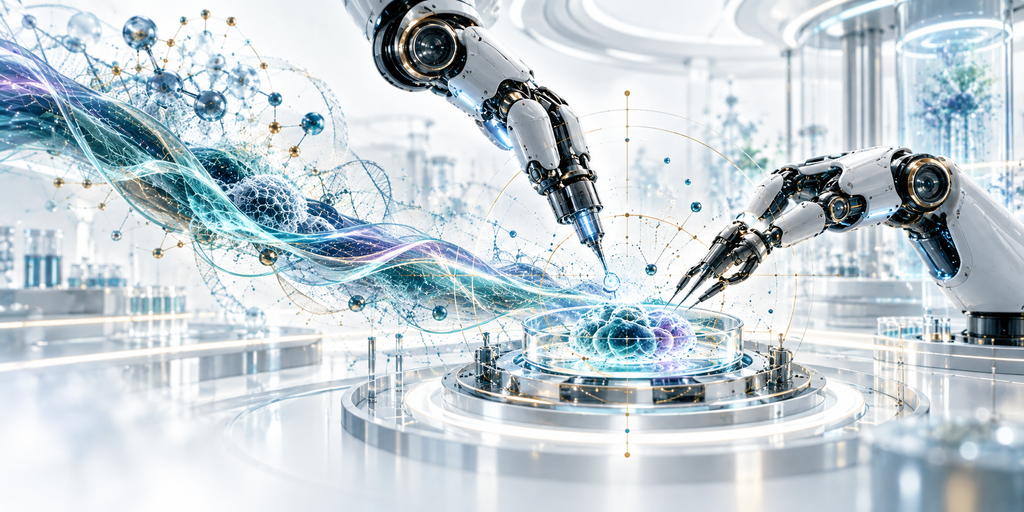
Research published in Nature Chemical Engineering described a self-driving laboratory system for protein engineering that connected computational design with robotic experimentation and measurement. The application demonstrates the underlying principle: a model can contribute to a continuous experimental process rather than remaining an isolated source of predictions.
The distinction is profound for scientific commercialization.
A model can generate thousands of promising enzyme designs. Those predictions acquire greater value when reliable laboratory systems test whether the proposed variants actually perform as intended. Physical experimentation introduces the constraints that determine which candidates deserve further development.
The machine becomes part of the production of scientific evidence.
This is also where scientific automation begins to encounter the familiar difficulties of industrial scale. A successful experiment under controlled laboratory conditions does not establish that the resulting biology is economical to manufacture, stable under relevant conditions, or appropriate for a regulated application. Automation can increase the speed of experimentation while leaving downstream development problems unresolved.
A commercially sophisticated laboratory therefore connects experimental capability to intended application, analytical requirements, manufacturability, and the economic implications of further development.
The purpose is to generate knowledge that can survive its movement into the next stage.
The Emerging Pharmaceutical Example
In January 2026, NVIDIA and Eli Lilly announced a research collaboration involving planned investment of up to $1 billion over five years in infrastructure, talent, and computing. The companies described an ambition to connect computational drug research with physical experimentation and explore robotics, AI, and digital twins across scientific and manufacturing activities.
This announcement is important because it connects advanced AI infrastructure with the practical architecture of pharmaceutical research. The opportunity is no longer limited to producing computational predictions that a separate laboratory later investigates. The emerging model links computational systems with experimental processes capable of generating new evidence and returning that evidence to inform subsequent analysis.
The ambition is substantial, and the results will need to be evaluated through actual scientific and operational performance. A research announcement is evidence of strategic commitment, not proof that every intended application has been achieved.
Nevertheless, the direction is clear.
Pharmaceutical development contains numerous activities in which computation and experimentation must repeatedly inform one another. These include molecular design, analytical testing, formulation development, process characterization, equipment monitoring, and manufacturing optimization. The ability to connect appropriate parts of these workflows offers opportunities to reduce delays, improve consistency, and support better-informed decisions.
It also changes the commercial environment for suppliers.
Laboratory equipment manufacturers may need to integrate more sophisticated software and communications capabilities. Automation developers may need greater familiarity with biological workflows. AI companies may need specialized experimental partners. Biomanufacturing organizations may have opportunities to apply more intelligent monitoring and development tools, subject to the validation and quality requirements of their operating environments.
For investors, the value can accumulate in several places: software platforms, instrumentation, automation systems, computational infrastructure, data governance, and service providers capable of integrating these technologies into functioning scientific operations.
The largest opportunity is not necessarily a robot that resembles a scientist. It is a laboratory capable of learning through a more reliable and economically productive relationship between prediction and experiment.
The Difference Between Doing More Experiments and Learning More
Automation creates a tempting assumption: if a laboratory can perform experiments faster, it will necessarily produce knowledge faster.
That conclusion depends on the quality of the experimental strategy.
A laboratory can generate enormous numbers of measurements without resolving the scientific questions that matter. It can optimize a parameter that has little significance for the eventual product. It can produce results that are difficult to compare because the methods changed during development. It can discover a promising condition that fails under manufacturing constraints.
The challenge is therefore to organize experimentation around decisions.
A useful scientific automation platform should establish what it seeks to learn, which uncertainties matter most, how a result changes the next action, and whether the resulting knowledge remains applicable beyond the immediate experimental environment.
This is where embodied intelligence meets venture and industrial strategy. Experimentation consumes materials, equipment time, engineering resources, and capital. Faster experimentation creates value when it reduces consequential uncertainty, improves development decisions, or enables an economically important result.
The same distinction appears throughout advanced technology.
A robot that moves faster without improving usable output creates limited value. A processor that calculates more efficiently without meeting customer requirements may struggle to find a market. A sensor that generates more information without improving decisions contributes additional complexity.
The measure of intelligence is revealed in what becomes possible after it acts.
The real transformation occurs when scientific systems begin to coordinate their capabilities around meaningful outcomes: selecting experiments with greater discipline, generating trustworthy measurements, preserving the history of decisions, and transferring the resulting knowledge into development and production.
At this point, Dream Manifest becomes a question of commercial architecture. The relevant technologies already span semiconductor research, robotics, instrumentation, biotechnology, manufacturing, and data infrastructure. Their individual advances matter, but their combined value depends on how they are organized.
The next question is who will build these integrated systems, who will purchase them, where capital will accumulate, and what must happen before technological ambition becomes reliable industrial capability.
VI. From Demonstration to Industry: The Commercial Architecture of Physical AI
A Robot Becomes a Business When Its Work Can Be Repeated
The most important transition in physical AI is taking place between demonstration and deployment.
A machine performing a sophisticated task in a controlled laboratory establishes an important technical capability. A machine performing that task thousands of times, alongside workers, within defined safety requirements, at an economically acceptable cost, establishes an industrial proposition.
These are different achievements.
A robotics startup may demonstrate that its system can recognize unfamiliar objects and manipulate them successfully. The demonstration proves something about its perception, planning, and control capabilities. A prospective manufacturing customer must ask additional questions. How frequently will the task succeed? What happens after an unsuccessful attempt? How long does recovery take? What maintenance does the equipment require? How much time must employees spend supervising it? Can the system accommodate changes in product configuration? How much does integration cost, and how quickly will the investment recover that cost?
The commercial difference becomes visible when a machine leaves the controlled environment in which its designers understand every component and enters a customer’s operation, where the surrounding system has its own history, people, procedures, equipment, and constraints.
A factory cannot reorganize its entire existence around the preferences of a single robot. A pharmaceutical manufacturer cannot casually change a validated production process because a new automation platform prefers different instruments. An analytical laboratory cannot sacrifice measurement reliability to accommodate an otherwise sophisticated AI model.
The technology must meet the customer inside the customer’s world.
This is the first commercial principle of embodied intelligence: a system creates value through its ability to participate reliably in an operating environment that existed before it arrived.
The future belongs to machines that can enter the world without demanding that the world be rebuilt around them.
The Biomanufacturing Example
One of the clearest emerging applications is robotic biologics manufacturing.
Cell therapies, viral vectors, and other advanced biological products can involve complex sequences of material handling, processing, sampling, and documentation. Some procedures remain labor-intensive, and the coordination of equipment, cleanroom operations, and qualified personnel can place limits on throughput.
The opportunity for robotics is to improve the repeatability and coordination of suitable operations while preserving the requirements that determine product quality.
On October 6, 2026, Multiply Labs announced a $75 million Series B to expand its robotic manufacturing platform for biologics. The company describes a system that integrates existing manufacturing instruments into robotic clusters, aiming to automate operations without requiring customers to abandon their established processes. Its published materials report significant potential improvements in throughput and cost per dose, although those company-reported performance figures require evaluation in the specific manufacturing contexts where customers intend to deploy the system.
The commercial significance extends beyond any individual performance claim. Multiply Labs is pursuing a manufacturing problem that potential customers already understand: biological therapies are becoming more sophisticated, while many production processes remain expensive, operationally demanding, and difficult to scale.
That is a substantially different market position from developing a robot and searching afterward for a reason someone should purchase it.
The distinction matters for biotechnology commercialization. A platform that reduces contamination risk, limits repetitive interventions, supports traceable execution, and increases useful manufacturing capacity could create value through improved production economics. But those benefits must be demonstrated within appropriate quality and regulatory systems. Automation itself does not establish GMP compliance, and new software or equipment can create additional qualification responsibilities.
The FDA’s February 2026 guidance on computer software assurance for production and quality management systems in medical-device manufacturing reinforces the importance of a risk-based approach to establishing confidence in automation. Pharmaceutical and biological manufacturing also operate under their respective regulatory and quality frameworks, which must be evaluated separately.
The broader lesson is that the most successful physical AI companies will understand what their customers are already required to accomplish.
A commercially effective machine enters a production system to improve the system’s performance, not simply to demonstrate the machine’s intelligence.
The Infrastructure Around the Robot
A robotics product is rarely one product.
It is an assembly of mechanical components, sensors, electronics, software, models, communications, safety mechanisms, maintenance arrangements, and commercial support. Each component may be supplied by a different specialist.
This creates a substantial opportunity for companies that never manufacture a complete robot.
A precision optical manufacturer can supply components needed for machine perception. A semiconductor developer can improve local inference. An industrial software company can coordinate data and workflow. A calibration specialist can help establish reliable measurement. An automation integrator can connect the technology with existing equipment. A cybersecurity company can protect identities, communications, and access to consequential operations.
The commercial ecosystem becomes more valuable as these capabilities become easier to combine.
For venture investors, this suggests that an attractive physical AI investment does not always have to be a humanoid robotics company. Component suppliers, specialized infrastructure providers, developer platforms, and industrial integrators can address important constraints without assuming responsibility for every aspect of a complete machine.
The challenge is identifying which capabilities remain valuable as the ecosystem matures and which will become standardized, inexpensive, or easily substituted.
VII. The Next Industrial Frontier: Twelve Emerging Opportunities
Computing, Models, and the Cost of Intelligence
The first cluster of opportunities concerns how intelligent systems acquire the computational capacity to operate in physical environments.
Edge AI is becoming important because machines often need to process information close to the place where it is generated. The benefit can include reduced latency, less dependence on continuous connectivity, and greater control over where sensitive information travels. Companies able to deliver meaningful system-level performance improvements under realistic energy and cost constraints may find opportunities across industrial equipment, portable instruments, and autonomous devices.
Neuromorphic computing represents a more experimental branch of this opportunity. Its commercial prospects depend on identifying workloads where specialized hardware can outperform existing alternatives after accounting for software, manufacturing, peripheral circuitry, and integration. Successful companies will need convincing benchmarks rather than broad promises about brain-inspired efficiency.
Robotics foundation models may help reduce the amount of task-specific software required for certain machines. Yet physical training data are expensive to generate, and performance can deteriorate when an environment changes. Model quality, adaptability, safety, and the cost of acquiring representative experience will therefore shape competition.
Simulation and synthetic-data infrastructure are becoming increasingly significant. NVIDIA’s 2026 physical-AI announcements have emphasized world models, robotics simulation, and evaluation tools alongside processors and robot models. Simulation can accelerate development, although behavior learned in a simulated environment still requires testing against physical reality.
These opportunities are connected. Better computing helps models operate locally. Better simulation helps generate training experience. Better evaluation reveals where a model’s behavior becomes unreliable. Together they determine whether an intelligent machine can perform useful work beyond its original demonstration.
Sensors, Measurement, and Physical Interaction
A second cluster concerns the equipment that connects computation to the material world.
Multimodal sensing combines information from cameras, force sensors, lidar, inertial devices, thermal systems, and other instruments. The objective is a more reliable representation of the environment than any single sensor can provide. Its commercial importance will depend on calibration, synchronization, signal interpretation, and the cost of integrating complementary technologies.
Intelligent photonics connects optical measurement with increasingly capable computational systems. This creates opportunities in industrial inspection, medical instrumentation, autonomous navigation, scientific imaging, and advanced manufacturing. A semiconductor or robotics company may develop exceptional processing capabilities while depending on specialized optical partners to produce measurements worthy of interpretation.
The deeper engineering and commercial issues are explored in optical calibration and intelligent sensing, where photons, precision manufacturing, and reliable measurement converge into useful information.
Advanced actuators and robotic manipulation constitute another important field. A model may understand the desired movement, but the machine must execute it through motors, transmissions, mechanical structures, and control systems with finite force, precision, and durability. Dexterous manipulation remains an important challenge when objects vary in geometry, texture, weight, and flexibility.
These are opportunities for companies whose inventions are rarely visible in promotional videos. The performance of an intelligent machine depends as much on the components through which it encounters the world as on the model through which it interprets that encounter.
Laboratories, Factories, and Distributed Intelligence
The third cluster concerns applications in which intelligent machines already have identifiable customers.
Autonomous scientific experimentation connects computational planning, automated equipment, measurement, and research interpretation. Its commercial promise lies in making experimental cycles more productive and preserving usable evidence as programs progress toward development.
Robotic biomanufacturing can address repetitive handling, process coordination, and production bottlenecks. Its adoption will depend on compatibility with existing workflows, qualification requirements, capital cost, equipment reliability, and measurable manufacturing benefits.
Industrial predictive intelligence can use sensors and local models to detect abnormal conditions, support maintenance planning, and reduce unnecessary interruptions. The business case should be demonstrated through reduced downtime, improved reliability, or other operational outcomes rather than model accuracy alone.
Digital twins and adaptive production systems connect measurements from physical equipment with computational representations used to understand performance or investigate operating scenarios. Their usefulness depends on the fidelity of the model, the reliability of incoming data, and the decisions the representation supports.
Across these fields, a common transition is underway. Intelligence is moving from the production of recommendations toward participation in processes where the output must have physical and economic value.
Trust, Authority, and Commercial Ecosystems
A fourth cluster concerns the infrastructure governing participation.
Cyber-physical security and device identity become increasingly important when software systems can initiate actions involving equipment, biological materials, or sensitive information. A system must establish which device is communicating, whether its software and instructions are trustworthy, and what actions are authorized.
Cross-industry technology commercialization becomes more attractive as similar sensing, computing, and control capabilities appear in medical devices, laboratory automation, aerospace systems, and industrial robotics. Specialized companies can explore adjacent markets, but success depends on qualification, purchasing requirements, competitive alternatives, and the economics of entering each industry.
These twelve developments should be understood as connected technical and commercial directions, not twelve guaranteed investment winners. Some are already mature business categories. Others remain development-stage opportunities. Their relative importance will change as technical performance improves and customers discover which capabilities produce measurable value.
What unites them is the movement of intelligence into consequential environments.
VIII. The Venture Economics of Embodied Intelligence
What Investors Should Actually Underwrite
The investment appeal of physical AI is straightforward: many industries contain valuable work that remains physically demanding, repetitive, expensive, difficult to staff, or insufficiently automated.
The risk is that technological ambition can obscure the costs of creating a deployable product.
A robotics company may demonstrate extraordinary manipulation capability while remaining several years away from a commercially viable manufacturing system. A semiconductor startup may show remarkable efficiency in a laboratory array while facing substantial manufacturing and software challenges. A scientific automation company may perform experiments rapidly without yet establishing an attractive return on the customer’s equipment investment.
Investors need to examine the distance between technical evidence and commercial consequence.
A useful starting point is technical readiness. What has actually been demonstrated, under which conditions, using what equipment? Has a prospective customer independently evaluated the result? Does the performance advantage survive when the complete system is measured?
The next question is integration readiness. Can the technology enter existing operations without imposing excessive implementation costs? How much engineering support is required? Must the customer’s equipment, software, or workflow be replaced? Are specialized certifications or quality-system activities necessary?
The third question is commercial readiness. Who owns the purchasing decision? What budget supports the purchase? Which alternatives currently solve the problem? What evidence would persuade the customer to expand from a pilot to a wider deployment?
Finally comes capital efficiency. How much financing must be invested before the company reaches repeatable production, a sustainable service model, or licensing revenue? Semiconductor manufacturing, advanced robotics, and regulated instrumentation each impose different capital requirements. Their financial models should reflect those differences.
In October 2026, Omron announced its planned $675 million acquisition of U.S. industrial-computing company OnLogic and its parent company to strengthen its industrial physical-AI capabilities. The transaction illustrates the strategic value that established automation businesses may assign to industrial computing infrastructure. It does not establish that every emerging processor or robotics platform will command similar economics.
Capital follows credible pathways to value, not technological possibility alone.
The Economic Equation Inside a Machine
Suppose a manufacturer is evaluating an intelligent robotic system for a repetitive handling process.
The proposed machine costs $400,000 to purchase and integrate. The company expects it to create $150,000 in annual gross labor, quality, and throughput benefits. Its continuing maintenance, support, energy, and operational costs total $40,000 per year.
The simplified annual net benefit is therefore $110,000.
Ignoring financing, taxes, changes in production volume, and the time value of money, the initial investment would have a simple payback period of approximately 3.6 years.
That estimate may be attractive in one factory and unacceptable in another. A customer facing severe capacity constraints may value additional output more highly than a customer operating below capacity. An organization handling expensive biological materials may value reduced contamination exposure. Another may be unwilling to assume the operational risks of introducing new equipment.
Even the apparent labor benefit requires careful evaluation. Some workers may remain necessary for supervision, quality decisions, maintenance, and handling exceptions. An automated system may shift labor requirements rather than eliminate them.
A credible commercial model must therefore include utilization, error and recovery rates, support responsibilities, maintenance, integration costs, and the consequences of downtime.
A robot becomes valuable when its intelligence survives a balance sheet.
The same reasoning applies to AI hardware. A claimed improvement in computational efficiency matters commercially when it produces a meaningful product-level advantage: longer battery life, lower cooling requirements, faster response, reduced infrastructure spending, or an application that could not previously operate within available constraints.
Performance becomes revenue only through a purchasing decision.
Five Business Models Worth Watching
The commercial architecture of embodied intelligence will include several different approaches.
An equipment manufacturer can sell complete machines and earn additional revenue through software, service, and maintenance. A robotics-as-a-service provider can reduce the customer’s initial capital requirement by charging for access or usage, while assuming greater responsibility for financing and operating the equipment. A component supplier can manufacture specialized sensors, processors, actuators, or subsystems for established OEMs.
A software platform can provide robotics models, simulation, control systems, or development infrastructure. An intellectual-property company may license patented technology to manufacturers able to integrate it into commercial products.
Each model creates different incentives and risks.
A hardware seller must manage production quality and customer support. A service provider must understand utilization, equipment financing, and operational responsibility. An IP licensor must establish clear technical advantages, enforceable rights, and a compelling reason for partners to adopt its architecture.
No one model should be treated as universally superior. The right commercial structure depends on the technology, customer, market maturity, and capital available.
For a founder, the strategic challenge is choosing a model that reflects what the company can repeatedly deliver.
IX. The Secure Machine: Intelligence, Identity, and Authority
Capability Creates a New Responsibility
A machine capable of performing consequential actions creates a need for equally sophisticated governance.
Consider an autonomous laboratory system preparing an experimental sequence. Its planning model identifies a useful experiment, an integrated instrument receives instructions, and equipment begins handling physical samples. The computational system may be functioning exactly as designed, but the broader operation still depends on permissions, approved procedures, data provenance, and the integrity of the connected equipment.
Who authorized the experiment? Which software version generated the recommendation? Has the instrument’s configuration changed? Who can interrupt the operation? What information will establish that the procedure occurred as recorded?
These questions sit at the intersection of robotics, scientific governance, and biomanufacturing cybersecurity.
Secure operation requires more than an encrypted communication channel. A responsible architecture must account for device identity, user permissions, software updates, reliable records, independent safety controls, and recovery when part of the system fails.
It must also distinguish the authority to interpret information from the authority to act.
A computational model may suggest a new manufacturing parameter. That recommendation does not automatically confer permission to alter an approved process. An industrial system may recognize an apparent anomaly without possessing authority to override a human operator or circumvent established controls.
The importance of these boundaries grows as intelligent systems become more autonomous.
The future will require increasingly capable machines. It will also require increasingly precise answers to the question of who governs their capabilities.
The Architecture of Human–Machine Participation
A sophisticated operating system involves multiple forms of participation.
The sensor supplies observations. The computational model organizes those observations into usable information. The controller translates decisions into commands. The actuator produces physical effects. The human operator, organization, and applicable governance systems establish the permissions and responsibilities under which those effects are allowed to occur.
The resulting structure is relational. Its success depends on the integrity of the connections among its participants.
This is where the philosophical distinction between Mind and Body becomes commercially useful. A system’s capacity to organize relationships grows through information, computation, and coordination. Its Body establishes where that organization becomes locally consequential. As machines become capable of more complex actions, the quality of those relationships determines whether greater capability produces reliability or merely creates new forms of fragility.
The more freely intelligence can act, the more precisely responsibility must be organized.
That principle applies to robotics, autonomous laboratories, scientific software agents, medical devices, and industrial production platforms.
The objective is to build systems where capabilities expand together with accountability.
X. Markets Merging: Why the Next Robotics Company May Not Begin in Robotics
The Transfer of Capability Across Industries
Technological markets often appear separate because their customers, regulations, procurement systems, and professional communities differ. Beneath these differences, however, their products may depend on many of the same technical capabilities.
Precision sensing is relevant to autonomous vehicles, laboratory instruments, aerospace payloads, industrial inspection, and medical imaging. Specialized materials can influence the performance of optical systems across these environments. Efficient computing supports local intelligence wherever power, latency, or communications constrain operation. Robotics can automate physical processes in industries that developed long before contemporary AI.
This creates an important venture-development opportunity: identifying a capability whose value has already been demonstrated in one industry and determining whether another industry has reached the point of needing it.
The full investment and commercial strategy is explored in: Markets Merging: The New Industrial Economy of Biology, Defense & Space.
The difficulty is that technical transfer and commercial transfer are different processes.
A sensor manufacturer may discover a valuable medical application but need new regulatory expertise and clinical partners. A robotics company accustomed to automotive assembly may find opportunities in biomanufacturing but encounter unfamiliar requirements for contamination control, electronic records, and quality systems. A semiconductor company may produce a useful low-power processor but need established instrument manufacturers to bring the component into a commercially viable product.
This is where venture architecture becomes practical. The company must identify the target customer, translate its capabilities into that customer’s operating language, evaluate competing solutions, understand qualification costs, and establish the partnerships required to deliver a complete system.
A technology can cross industries faster than a company can learn to sell it.
That gap creates demand for specialized commercialization expertise.
Why the Bioeconomy Is a Valuable Entry Point
Biotechnology is an especially interesting market for intelligent machinery because it combines scientific complexity with numerous physical operations.
Biological production requires preparation, measurement, handling, control, documentation, and interpretation. Diagnostic instruments combine sensing and analysis. Research laboratories depend on increasingly sophisticated equipment. Pharmaceutical development connects experimentation with regulated industrial processes.
These are environments in which useful advances in physical AI could produce measurable operational value.
They are also environments that resist exaggerated claims. Products must satisfy specific scientific and commercial requirements. Engineering performance matters. Manufacturing reliability matters. Quality and safety obligations matter. Customers require evidence.
For the same reason, biotechnology can be a valuable proving ground for emerging computing, photonics, robotics, and sensing companies.
A system that succeeds inside a demanding scientific workflow establishes knowledge about integration, reliability, and customer requirements that may be useful in adjacent markets.
The relationship is reciprocal. Biotechnology can benefit from intelligent machinery, while emerging hardware companies can benefit from the difficult, well-defined problems biotechnology presents.
The most interesting market opportunity may emerge at the place where neither industry was originally looking.
XI. Dream Manifest: The Industrial Future of an Imagined World
The history of technology is filled with ideas that appeared long before the physical conditions necessary to realize them.
Human beings imagined artificial servants, speaking machines, autonomous vehicles, and instruments capable of extending perception beyond the natural capacities of the body. These possibilities entered language, mathematics, mechanical design, electronics, and eventually computation. Their development was neither continuous nor inevitable. Progress required scientific knowledge, manufacturing capability, capital, experimentation, and generations of work.
Physical AI represents another movement within this history.
We have constructed computational systems capable of organizing extraordinary quantities of information. We are now developing increasingly capable physical systems through which some of that organization can act upon the world. The resulting technologies will encounter familiar industrial constraints: energy, materials, precision, safety, scale, quality, cost, and the need for reliable human participation.
Their future will depend on how these constraints are organized.
A model cannot substitute for a dependable instrument. An instrument cannot substitute for a commercially viable process. A compelling prototype cannot substitute for manufacturing. Capital cannot substitute for evidence, although it can finance the work required to produce it.
The most consequential companies will connect these capabilities rather than treating each as an isolated achievement.
Dream Manifest is the movement from imagined possibility into organized physical consequence. It describes the relationship among language, intelligence, engineering, and the material systems through which new capacities become real.
It also expresses an obligation.
If humanity gives intelligence increasingly powerful forms through which to act, we must build the infrastructure that makes those forms useful, understandable, and accountable.
The future of embodied intelligence will not be decided by the machines that look most impressive in isolation. It will be decided by the systems that perform valuable work, preserve trust, and allow their capabilities to become part of ordinary industrial life.
Dream becomes history when it acquires a Body.
And the most important question for the next generation of founders, scientists, engineers, operators, and investors is what kind of world that Body will help create.
Frequently Asked Questions
What is physical AI?
Physical AI refers to intelligent computational systems integrated with machines that perceive and act in the physical world. Examples include intelligent industrial robots, autonomous laboratory equipment, robotic inspection systems, and other devices whose behavior combines sensing, computational interpretation, and physical action.
What is embodied intelligence?
Embodied intelligence describes intelligent behavior arising through the interaction of computation, sensing, a physical system, and its environment. In robotics, it concerns the capacity to use environmental information to guide actions within the constraints of the machine’s actual mechanical and electronic capabilities.
How is neuromorphic computing related to robotics?
Neuromorphic computing investigates architectures inspired by aspects of biological information processing. Some approaches may improve energy efficiency or latency for suitable AI workloads, potentially benefiting robots and sensors operating under constrained power or communication conditions. Commercial advantages must be established through relevant full-system comparisons.
How can physical AI improve biotechnology?
Potential applications include intelligent laboratory automation, robotic sample handling, scientific imaging, analytical instrumentation, process monitoring, and selected manufacturing operations. The value depends on whether the systems improve useful output, reproducibility, reliability, or operating economics while satisfying applicable scientific and quality requirements.
What are the main commercial challenges for robotics startups?
Important challenges include system reliability, manufacturing cost, integration with customer operations, safety, maintenance, training-data requirements, technical validation, customer purchasing behavior, and the capital needed to scale. A successful demonstration is an early milestone rather than proof of a repeatable business.
Why are photonics and cybersecurity important to intelligent machines?
Photonics provides technologies for measuring and interpreting the physical environment through light. Cybersecurity helps protect the software, identities, information, communications, and permissions that govern machine operation. Both become increasingly important as intelligent machines operate with greater independence in consequential settings.
Further Reading
- International Federation of Robotics — World Robotics 2026
- Google DeepMind — Gemini Robotics On-Device
- NVIDIA — Physical AI Models and Robotics Infrastructure, January 2026
- NVIDIA — Global Robotics Partnerships, March 2026
- Multiply Labs — Series B Announcement, October 2026
- FDA — Computer Software Assurance, February 2026
- ISO 10218-1:2025 — Industrial Robot Safety Requirements